
"The "Schwartz Value Survey," created by Shalom Schwartz at Hebrew University, Israel."
Test Source: YourMorals (accessed after first test)
"The idea behind the scale is that there is an internal order and structure to values. Using various statistical techniques, Schwartz has found that the ten basic human values show a pattern of relationships that can be graphed as a circle. Values that are next to each other are closely related; values that are across from each other tend to be opposed, or tend not to be strongly endorsed by the same person. Political liberals have been found to endorse the "openness to change" values, while conservatives are more likely to endorse the "conservation" values. We have put this scale up on YourMorals because we are interested in learning how Schwartz's ten values (which include moral and non-moral values) relate to the "five foundations of morality" theory from Haidt and Graham, as measured by the "Moral Foundations Questionnaire."
To learn more, you can read these papers:
Schwartz, S. H. (2006). Basic human values: An overview.
Schwartz, S. H. (1992). Universals in the content and structure of values: Theoreticaladvances and empirical tests in 20 countries
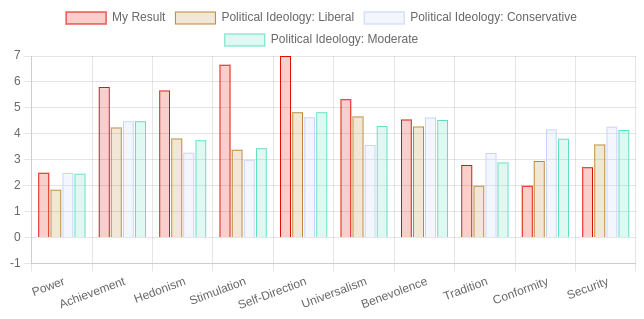

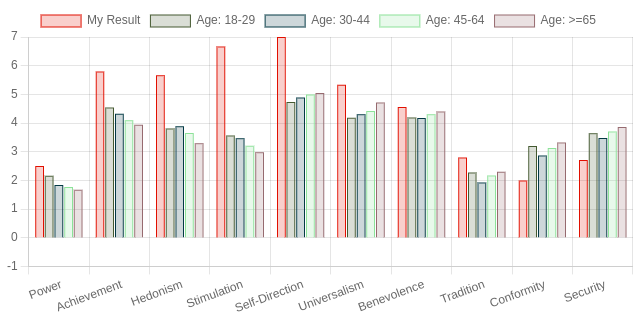
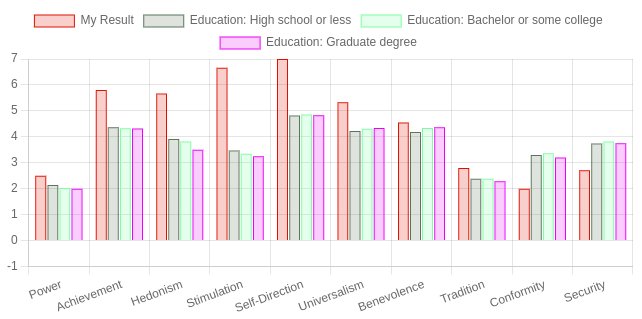
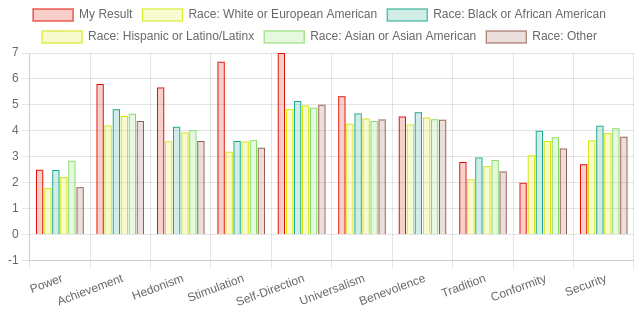
Social status and prestige, control or dominance over people and resources.
Personal success through demonstrating competence according to social standards.
Pleasure or sensuous gratification for oneself.
Excitement, novelty, and challenge in life.
Independent thought and action - choosing, creating, exploring.
Understanding, appreciation, tolerance, and protection for the welfare of all people and for nature.
Preservation and enhancement of the welfare of people with whom one is in frequent personal contact.
Respect, commitment, and acceptance of the customs and ideas that traditional culture or religion provide.
Restraint of actions, inclinations, and impulses likely to upset or harm others and violate social expectations or norms.
Safety, harmony, and stability of society, of relationships, and of self.